MEMBERS ONLY: To gain full access to the Half Yard Club projects please login or sign up
Zero-Waste Jacket Sewing Pattern | The Great British Sewing Bee
Easy |

Quick Links: What you'll need Project steps
We're celebrating The Great British Sewing Bee with this amazing Zero-Waste Jacket project.
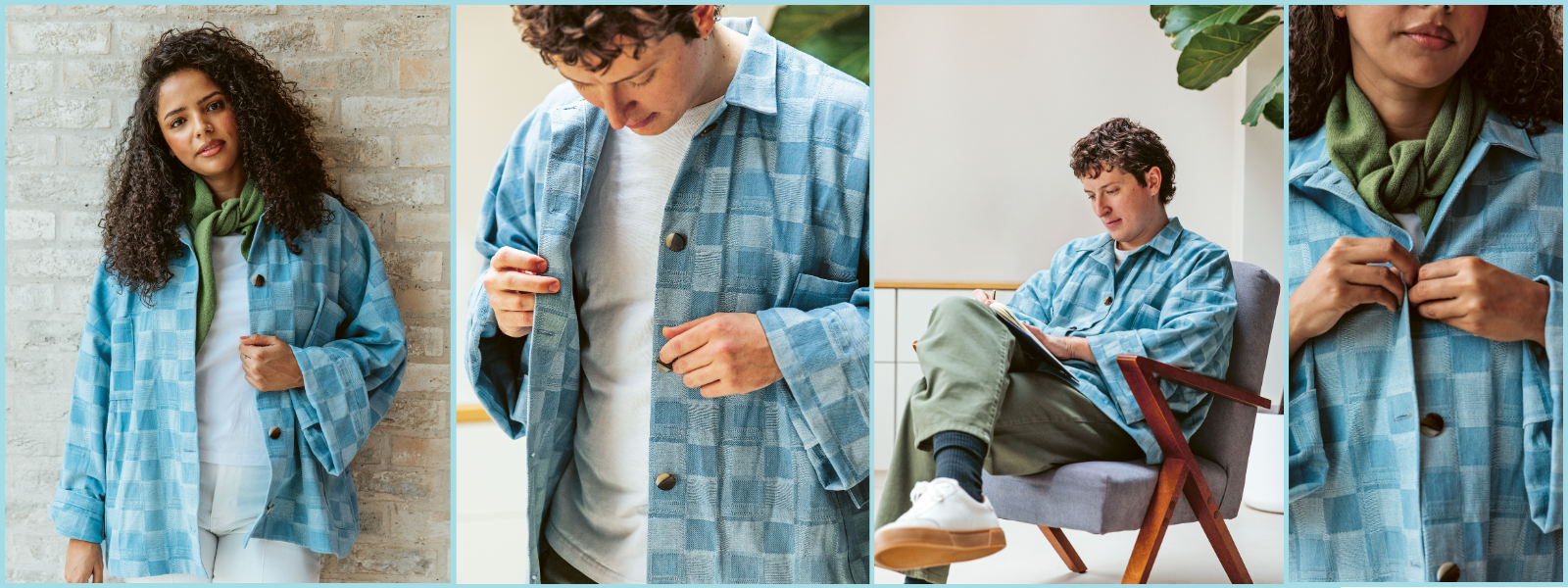
We've teamed up with Quadrille to bring you this fabulous project from a brand new book, The Great British Sewing Bee: Everyday Style. This is a zero waste design, meaning that the pattern pieces utilise the entire fabric. The jacket has patch pockets and a boxy, unisex fit.
The size of the jacket depends on the width of your fabric. Common fabric widths are 140cm (55in) and 160cm (63in); the wider the fabric, the bigger your jacket will be. This is a great project for either a high-quality plain fabric or something with a print that complements the utilitarian feel of the jacket.About the book
The Great British Sewing Bee: Everyday Style. is the official companion to Series 12 of the hit BBC One show. You can bring the fun of the show straight into your own home through creating a stylish, wearable wardrobe you’ll reach for every day. Discover a curated collection of the show’s favourite patterns, designed to help you build a versatile capsule collection with confidence.Member discount
Don't forget, you can get 30% off this book with your member discount. Simply add The Great British Sewing Bee: Everyday Style to your basket and apply the code at the check-out stage.
FOR A FABRIC 140CM (55IN) WIDEFinished garment measurements:
Bust/chest: 126cm (49 1/2in)
Sleeve length: 54cm (21 1/4in)
Nape to hem: 73cm (28 3/4in) FOR A FABRIC 160CM (63IN) WIDE
Finished garment measurements:
Bust/chest: 154 cm (60 1/2in)
Sleeve length: 54 cm (21 1/4in)
Nape to hem: 73 cm (28 3/4in) Note: use a 1cm (3/8in) seam allowance throughout, unless otherwise stated.
Our sample was made using a 160cm (63in) wide denim jacquard. You can use lightweight canvas, denim, corduroy, heavyweight linen or cotton twill.
For reference, the female model is a size 18/20 and the male model a size L.
There are only two pattern pieces that you need for this project; they are located on the button above. When you get to step one of the Prepare the Pieces section, please see the following instructions: There are two main methods for finishing seams – overlocking and zigzagging. Unless specifically stated in the project instructions, you can use either.
Overlocking
Overlocking is the quickest and perhaps most common way of finishing seams and requires a separate machine with three or four threads. Domestic overlockers come with the option of threading them with three or four threads, whereas an industrial overlocker comes as either a three-thread or four-thread machine. When using three threads, an overlocker uses only one needle; with four threads, the machine uses two needles. A three-thread overlocker is perfect for all general use, whereas a four-thread overlocker is recommended for stretch fabrics. The double needle makes a double stitch line, which makes it extra strong and therefore suitable for garments that need to stretch. You don’t even have to sew your seam first when using a four-thread overlocker: you can overlock your pieces together straightaway and the double stitch line will act as the seam line. Make sure to maintain your overlocker well and remember to use finer threads than on your sewing machine. Once you’re a confident maker, it’s good to evaluate where it’s appropriate to use an overlocker and where it isn’t. An overlocked edge is bulkier, so use your knowledge to establish whether it would be better to finish the seam off in a different way. Regularly clean out your overlocker to get rid of all the fluff. This fluff clogs up the machine parts and makes the overlocker’s performance deteriorate. You will also need to change the blade that trims the fabric every once in a while, as it gets blunt and your results won’t be as neat. Follow your machine’s instructions on how to do this. If you need to order extra blades, make sure you order the blades that go with your brand of overlocker.
Zigzagging
If you don’t have an overlocker, you can always use the zigzag stitch on your sewing machine to finish off a raw edge. This doesn’t produce the same effect, but it’s the same principle: threads wrap around the raw edge to prevent it from fraying. The best method is to select a fairly wide stitch with a shorter length, to cover more of the raw edge. Position the raw edge under your machine so that the needle drops just off the raw edge before travelling to the other side. Dropping the needle off the edge is essential to this technique. Zigzagging was used until fairly recently as the principal method of finishing raw seam edges, so if you have a look at some vintage garments you will see lots of zigzagged seams. The Great British Sewing Bee: Everyday Style. (Quadrille, £30) Photography © 2026 Helena Dolby, Illustrations by Suzie London, Jemima Venn and Kate Simunek.
MEMBERS ONLY: To gain full access to the Half Yard Club projects please login or sign up
You will need:
Equipment
- Sewing machine
- Thread
- Scissors
Materials
- One 1.37m (1 1/2yd), 140-160 cm (55-63 in) wide, piece of fabric
MEMBERS ONLY: To gain full access to the Half Yard Club projects please login or sign up
Project steps:
Step 1
This is content that only logged members can see! Please create an account or login to be able to view project steps, otherwise you'll be limited to non-member content.
This is content that only logged members can see! Please create an account or login to be able to view project steps, otherwise you'll be limited to non-member content.
Step 2
This is content that only logged members can see! Please create an account or login to be able to view project steps, otherwise you'll be limited to non-member content.
This is content that only logged members can see! Please create an account or login to be able to view project steps, otherwise you'll be limited to non-member content.